Don Daredevil Rides Again Espaãƒâ±ol Latino

Commonwealth, 12 Capacity, 1951. Starring Ken Curtis, Aline Towne, Roy Barcroft, Lane Bradford, Robert Einer, John Cason, Hank Patterson.
The citizens of a Western ranching community suddenly detect themselves dispossessed when an quondam Castilian country grant–nether which they hold title to their ranches–is re-examined at the instigation of local attorney/politician Douglas Stratton (Roy Barcroft) and legally alleged a forgery. Now, their property is gratuitous country and belongs to the first homesteader who stakes a claim on it–and the land-grabbing Stratton is already planning to have his henchmen stake out every bit much valuable territory as they can. Still, lawyer Lee Hadley ((Ken Curtis) manages to file a claim on his cousin Patricia Doyle's (Aline Towne) property before Stratton'southward agents tin can, and encourages the other ranchers to do the same. To maintain championship to their new "claims," they must remain on the property for a yr–but Stratton is determined to brand sure none of them stick around that long, and has his followers launch a reign of terror in hopes of driving off the ranchers. With the Sheriff in Stratton's pocket, Hadley finds legal remedies useless, and instead decides to follow the case of his granddad–who in one case combated outlawry as the masked avenger "Don Daredevil." Every bit the resurrected don, Hadley fights to protect his friends and neighbors from Stratton'south gang, while also endeavoring to show that Stratton engineered the whole free-land situation past substituting a forgery for the original Spanish grant.
Don Daredevil Rides Once again is in nearly regards a typical late Commonwealth serial; though full of stock footage and repetitiously plotted, its new footage is adept plenty and its running fourth dimension short enough to make information technology quite enjoyable. Dissimilar many of its contemporaries, information technology also manages to successfully conceal its low budget–since, as a Western, information technology'south happily costless from the over-ambitious sci-fi or espionage trappings of many other belatedly Republics.
Ronald Davidson's screenplay for Don Daredevil largely consists of a series of encounters between Don Daredevil and Stratton's henchmen Weber and Hagen, with the masked man continually battling the heavies' attempts to destroy the homesteaders' holding. The subplot of the forged state grant isn't utilized as much every bit it could have been, although information technology does give ascent to a cursory plot detour in Chapter Five, and plays an important office in the serial's eventual denouement. Other detours are provided by the temporary arrest of Weber, the discovery of gold on 1 of the endangered homesteads, the villains' attempt to kill Lee Hadley, and the near-unmasking of Don Daredevil after Hadley is wounded; these deviations from the central storyline don't really overcome the repetitiveness of the serial's narrative, merely they do diminish information technology somewhat.
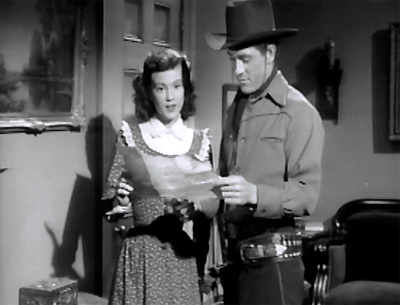
Above: Aline Towne and Ken Curtis examine the coveted land grant.
As whatever Commonwealth serial buff will realize upon seeing the star's costume, Don Daredevil derives much of its stock footage from Zorro'southward Blackness Whip (nearly notably the shots of the Don riding to and from his waterfall hideout); Daredevils of the W and The Phantom Rider are represented as well. However, in typical Republic style, the borrowed shots are so smoothly combined with new ones that fifty-fifty a buff has to await very carefully to spot the seams. Some pieces of in-chapter action–similar the attack on the wagons in the second episode or the buckboard hunt in Chapter Five–draw on stock footage, but the majority of the stock shows up in the chapter endings–among them the Chapter Eight tent explosion (Whip), the Chapter Two cliff-fall (Daredevils), and the Chapter Ane motel plummet (Passenger). New cliffhangers are less spectacular, such every bit the hero's apparent knifing at the finish of Chapter Five, the pitchforking in Chapter Ix, or the shooting in Chapter 10–although all 3 of these perils are resolved with to a higher place-average cleverness.


Above: Lane Bradford is most to pitchfork an unconscious Ken Curtis; the idea had been used before in Zorro's Blackness Whip, but the footage is make new.
Director Fred C. Brannon and the Republic stunt squad practise a solid job with the new action scenes–although the screenplay forces them to stage a rather excessive number of barroom brawls (similar the ofttimes-destroyed store in Haunted Harbor, the saloon in Don Daredevil is trashed so often by contesting heroes and villains that one wonders why it only doesn't shut downward). Of these saloon fights, the best and well-nigh energetically staged is the Chapter Nine i; this brawl also begins in novel mode, with Lee Hadley cagily managing to disarm a professional gunfighter who's trying to provoke him into a duel–and then energetically slugging it out with the killer on even terms. Tom Steele doubles the hero hither (and elsewhere); Dale Van Sickel plays the gunfighter.


Above left: Tom Steele ducks beneath a table every bit Dale Van Sickel crashes a chair against it. Above correct: Ken Curtis (not doubled in this shot) finishes Van Sickel off with a beautiful haymaker; both shots are from the Affiliate Nine fight.
Van Sickel also doubles for secondary hero Robert Einer and for action heavy Lane Bradford; Guy Teague tin also be seen doubling for Bradford in scenes that feature both the Einer and Bradford's graphic symbol–like the four-human ranch house fight in Chapter 5, which features Steele, Van Sickel, Teague, and Carey Loftin (doubling secondary henchman John Cason) all battling away. Steele's fight with Eddie Parker (doubling Roy Barcroft) in Chapter Eleven is also memorable, while Steele'southward various saloon slugfests with stuntmen Dave Sharpe, George Magrill, and Charles Horvath–though not as distinctive as the Chapter 9 one with Van Sickel–are quite respectable.
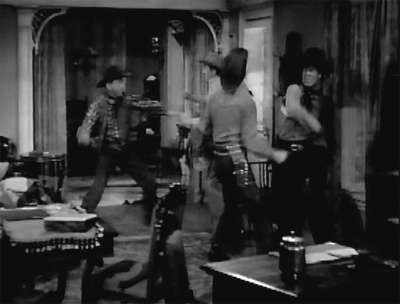
Above: Guy Teague slugs Tom Steele in the foreground, while Carey Loftin (checkered shirt) and Dale Van Sickel square off in the background.
The Chapter 3 barn fight (which concludes with a brief but interesting whip-versus-axe duel), Weber and Hagen's siege of the hero at a mine in Chapter Four, the shootout in the rocks in Chapter Seven, the gun battle betwixt homesteaders and claim-jumpers in Chapter Eight, and the satisfying climactic shootout at the Doyle ranch are good as well. The cliff and trails of Iverson'southward Ranch provide a properties for almost all of the serial's outdoor activeness sequences, except for scenes similar the opening shootout (which, similar the satisfying finale, takes identify at Republic'due south own backlot ranch).

Higher up: John Cason and Lane Bradford hunt embrace at Iverson's Ranch as Robert Einer (whose gunsmoke lonely is visible here) fires at them from above.
Star Ken Curtis displays little of the exuberance that marked his afterward "Festus Haggen" characterization on the Gunsmoke TV evidence; hither, he comes off as decidedly serious and subdued. Though somewhat lacking in affability, he'due south all the same quite likable–and handles other key aspects of the hero's role very well, carrying both grim toughness (when against crooks) and shrewd intelligence (in $.25 like the showdown with the gunfighter or in the powder-barrel scene in the terminal affiliate). His gaunt face, thoughtful expressions, and slow drawl give him a rather Lincoln-like air at times–quite appropriate for a supposed lawyer.

Above: Ken Curtis confronts Dale Van Sickel (dorsum to camera).
Heroine Aline Towne's quiet cheerfulness helps to rest out Curtis's somberness; she manages to come off as both calmly reflective and warmly earnest when joining him in discussions of strategy. Alternately clad in a riding skirt or sometime-fashioned dress–and wearing her hair long and flowing–she also looks lovelier here than in any of her other Republic outings (in which she was typically confined to concern suits and outer-infinite coveralls)–although, every bit in nigh of her serials, she has fairly little to exercise beyond conferring with the hero. Wonderful character actor Hank Patterson, as the trusty former cowpoke Buck, makes a welcome addition to the cast of good guys; like Towne, he spends virtually of his screen time at the Doyle ranch, but he notwithstanding enlivens many a dialogue sequence with his feisty grumblings. His urging of Hadley to take up the mantle of "ol' Don Daredevil" in the first affiliate is most enjoyable, while his confrontation with Stratton and the Sheriff in Chapter Ten is one of the series'due south all-time moments.

Above: Aline Towne and Hank Patterson disgustedly bargain with sheriff I. Stanford Jolley.
Robert Einer plays the series'southward fourth main protagonist–young rancher Gary Taylor, who's unaware of Don Daredevil's identity, simply does his best to assist him. Dissimilar most of the secondary heroes in Republic's serials, Gary is not a stolidly undecayed backup for the hero; instead, scripter Davidson writes the character as an impetous hothead, using his loose-cannon beliefs to provide a convenient just unusual goad for much of the action (and, incidentally, replenish one of Democracy'southward few genuinely funny fadeout scenes). Einer's performance in the part has been panned equally "weak" by most reviewers, but I find it difficult to agree with them; though he generally come off as doltish and bad-mannered instead of heroic, such an approach seems ideally suited to the immature blunderer he's playing. He also manages to exist suitably belligerent (as in his aroused disputes with the heavies) and cocky (as when he confidently assures the heroine he can handle potential trouble) when the state of affairs calls for it, only doesn't overdo either belligerency or cockiness to an obnoxious extent.

Higher up: Robert Einer every bit the shoot-starting time, talk-afterward Gary.
Roy Barcroft is characteristically splendid every bit the scheming Stratton; although the role gives him no opportunities to display the phony friendliness that characterized some of his other serial brains-heavy turns, he still derives plenty of mileage from Stratton's confident outlines of his plans, his sharp criticisms of his henchmen, and his unblushing attempts to overwhelm opponents with legal prevarications ("As an attorney, I assure you lot.."). As Weber and Hagen, Lane Bradford and John Cason make a first-rate henchman duo; both are intimidatingly mean and muscular, but are different enough in their screen personalities to exist an interesting team; Bradford'southward terse and articulate dialogue delivery and his ice-cold mode contrast nicely with Cason's growling vocalization, thick Texas emphasis, and gruffly downwardly-to-earth bearing.

Above, left to right: Roy Barcroft, John Cason, and Lane Bradford.
I. Stanford Jolley makes the virtually of his occasional appearances as the blustering and compromised Sheriff; Forrest Taylor is also lively in his brief scene as Gary'southward begetter (who, amusingly, seems about as imprudent as his son). Lee Phelps pops up as Uncle Michael Doyle, the holder of the disputed state grant, and Gene Roth has a practiced scrap equally the genial but gabby old rancher who dooms himself past hitting gilt in Chapter Seven. Mike Ragan (aka Holly Bane) makes a rare advent on the side of a right as a homesteader, while character player George Lloyd is delightful in his plow equally a shifty trader. The stunt team members all play various $.25, with Dale Van Sickel easily the most memorable in his same appearance as the quietly sinister gunfighter Dan Farley. Bud Osborne and Jack Ingram both announced as shifty bartenders, and cowboy musician Cactus Mack pops up as an outlaw.
Don Daredevil Rides Again offers nada new to the veteran serial-watcher, only makes for pleasant viewing yet; it's professionally crafted and full of likable actors–and is never hampered or embarrassed by its budget the fashion some of its contemporaries were. While The Invisible Monster fell curt of existence a sci-fi thriller, and Canadian Mounties vs. Atomic Invaders failed as a Common cold War espionage take chances, Don Daredevil easily realizes its more small goals–and succeeds every bit a compact and enjoyable Western chapterplay.

Source: https://filesofjerryblake.com/2014/01/09/don-daredevil-rides-again/
0 Response to "Don Daredevil Rides Again Espaãƒâ±ol Latino"
Post a Comment